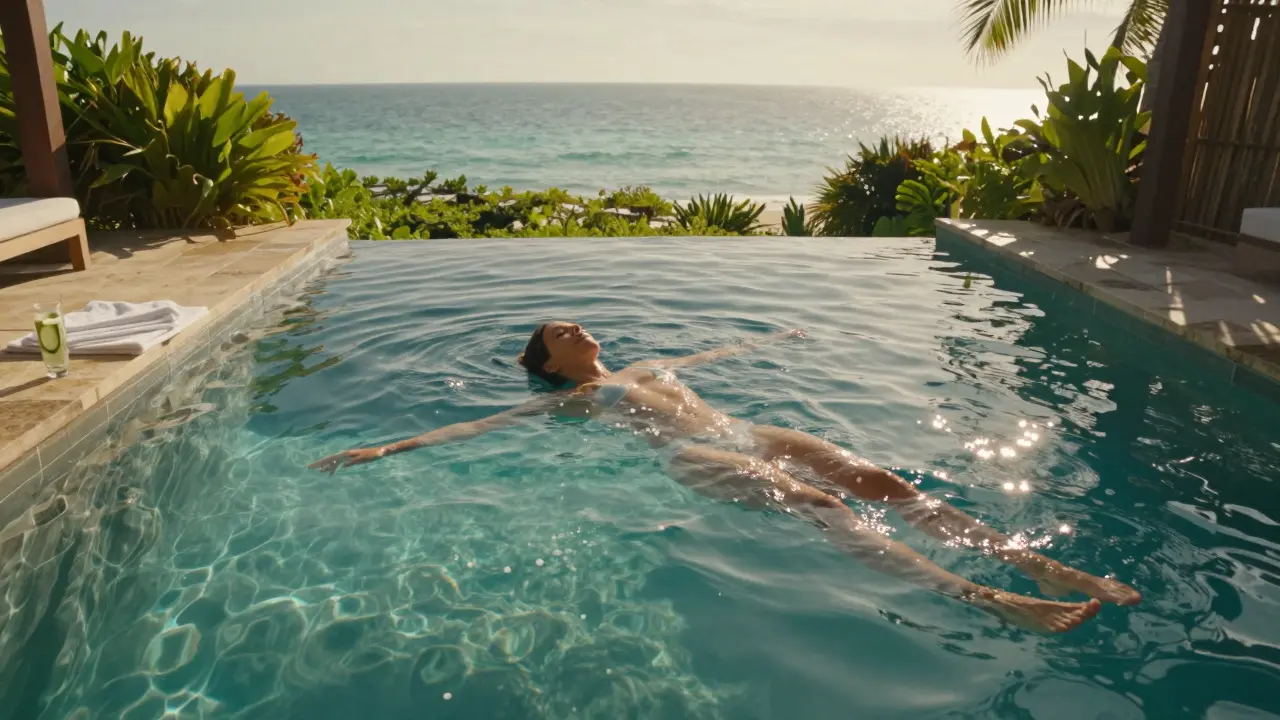
You’ve seen the videos-people floating effortlessly in water, arms drifting like seaweed, eyes closed, completely weightless. No gravity pulling you down. No pressure on your spine. No aching muscles. Just pure, silent calm. That’s not sci-fi. That’s zero gravity beach club bliss-and it’s real, and it’s here in 2025.
Imagine stepping into a pool where the water is heated to skin temperature, saturated with Epsom salt so dense you can’t sink. You lie back. Your body rises. Your shoulders float free. Your feet drift upward. Your ears are underwater, but your mind? It’s somewhere quiet. No phone. No noise. No one asking you to move. Just you, suspended in silence. This isn’t a spa treatment. It’s a reset button for your nervous system.
What Exactly Is a Zero Gravity Beach Club?
A zero gravity beach club isn’t a beach. It’s not even a pool in the traditional sense. It’s a sensory-deprivation tank, shaped like a sunken lounge chair, filled with 1,000 pounds of medical-grade Epsom salt dissolved in 1,000 gallons of water. The temperature? Exactly 93.5°F-your skin’s neutral point. When you enter, your body doesn’t feel the water. It doesn’t feel the air. It doesn’t feel gravity. You float. Not because you’re strong or balanced. Because physics says so.
These tanks were originally developed by neuroscientist John C. Lilly in the 1950s to study consciousness without sensory input. Today, they’re used by athletes, CEOs, and people recovering from chronic pain. You don’t need to be a yogi or a meditation guru. You just need to be tired. Really tired.
Why Zero Gravity Feels Like a Miracle
Your body carries around 130 pounds of pressure on your spine every single day. Sitting. Standing. Walking. Even sleeping doesn’t fully release it. In a zero gravity float, that pressure drops to zero. Your vertebrae gently separate. Your joints sigh. Your muscles unclench like fists opening after years of gripping.
Studies from the University of Michigan show that just 60 minutes in a float tank reduces cortisol-the stress hormone-by up to 21%. Blood pressure drops. Heart rate slows. Delta brainwaves, usually only seen in deep sleep, spike. You’re not sleeping. But your brain thinks you are.
People report things like:
- Chronic back pain disappearing for days after one session
- Insomnia improving after three visits
- Anxiety easing like a tide pulling back
- Clearer thinking, sharper focus, better creativity
One client, a nurse working 12-hour shifts in Vancouver, told me: "I went in thinking I’d just relax. I came out feeling like I’d slept for eight hours in 60 minutes. I cried in the parking lot. I didn’t know I was that tired."
Types of Zero Gravity Experiences Available Today
Not all float experiences are the same. Here’s what you’ll find in 2025:
- Classic Isolation Tanks-Closed, dark, quiet. Best for deep sensory deprivation. You’re completely alone. No music. No light. Just you and the salt.
- Open-Plan Float Lounges-Larger rooms with soft lighting and optional ambient sound. Good for first-timers who feel claustrophobic.
- Beach Club-Style Float Pools-These are the new trend. Think open-air, ocean-view, with towel service, chilled cucumber water, and post-float yoga mats laid out on the deck. They’re designed to feel luxurious, not clinical.
- Hybrid Float + Sound Bath-After floating, you lie still as Tibetan singing bowls vibrate through the air. The sound travels through the salt water, creating a full-body resonance.
The beach club style is the fastest-growing. Why? Because it removes the stigma. You don’t have to be a wellness guru to enjoy it. You just have to want to feel lighter.

How to Find a Zero Gravity Beach Club Near You
They’re popping up in major cities faster than coffee shops. In Vancouver, you’ll find them in Yaletown, Kitsilano, and near Granville Island. Look for places that say "floating spa," "sensory deprivation lounge," or "zero gravity pool."
Check reviews for these keywords:
- "Clean water"-If the water doesn’t smell like chlorine or feel slimy, it’s a good sign.
- "No pressure to buy packages"-Reputable places let you book one session.
- "Staff helps you relax"-They shouldn’t rush you in or out.
Most offer walk-ins, but booking ahead is smart. Weekday mornings are empty. Weekends? Book 48 hours out.
What to Expect During Your First Session
You’ll arrive, fill out a quick form, and be shown to a private suite. You shower first-no soap, no shampoo. Salt water doesn’t mix with residue. Then you step into the tank. You can leave the door open or close it. No one will check on you. You’re alone.
At first, you might feel like you’re sinking. Then, slowly, your body lifts. Your legs float up. Your head tilts back. Your ears go under. The water feels like silk. The air feels like nothing. You hear your own breath. Then, even that fades.
Time loses meaning. You might drift into a dreamlike state. Or you might just lie there, thinking about your grocery list. Both are fine. There’s no right way to float.
When the session ends, gentle music plays. You shower again-this time to rinse off the salt. Then you wrap yourself in a heated towel and sip warm lemon water. You’ll feel light. Not just physically. Mentally. Emotionally.
Pricing and Booking: No Surprises
Here’s what you’ll pay in 2025:
- One session: $75-$95
- Three-session pack: $200-$250 (about $67 each)
- Monthly membership: $250-$350 (unlimited, or 4-6 sessions)
Most places include everything: towel, shampoo, shower, post-float tea. No hidden fees. No upsells. You pay for the time, not the extras.
Book online. Most platforms let you choose your time, duration (60, 75, or 90 minutes), and even pick a room with ocean view or soft lighting. You can cancel up to 2 hours before-no penalty.
Safety Tips: It’s Safer Than You Think
Some people worry about drowning. You can’t. The water is so dense, you’d have to try. Even if you fall asleep, you stay on top. The salt is so high, it’s antibacterial. The water is filtered three times between each guest.
Who shouldn’t do it?
- People with open wounds or infections
- Those with severe epilepsy (consult your doctor)
- Anyone under the influence of drugs or alcohol
If you’re pregnant, it’s safe after the first trimester-many women say it’s the only time they feel their baby move without pressure. If you have claustrophobia, start with an open lounge. You’re always in control.
Zero Gravity vs. Traditional Spa: What’s the Difference?
| Feature | Zero Gravity Float | Traditional Spa Massage |
|---|---|---|
| Physical Relief | Zero pressure on joints and spine | Temporary muscle release |
| Stress Reduction | 21% drop in cortisol | 10-15% drop in cortisol |
| Duration | 60-90 minutes | 30-60 minutes |
| After Effects | Clear mind, deep calm, lasting 2-3 days | Relaxed muscles, but mental noise returns quickly |
| Requires Effort? | No. You just float. | Yes. You must relax during massage. |
| Best For | Anxiety, burnout, chronic pain, sleep issues | Tense muscles, post-workout recovery |
One isn’t better. They’re different. A massage fixes your shoulders. A float fixes your brain.
Frequently Asked Questions
Can you fall asleep in a zero gravity float?
Yes-and it’s safe. The saltwater keeps you floating, even if you’re completely relaxed. Many people do fall asleep. You’ll wake up gently when the music starts. No one drowns. No one gets cold. It’s like sleeping in a warm, silent cloud.
Do you need to wear a swimsuit?
No. Most people float naked. It’s the only way to fully remove sensory input. You’re in a private room with a lock. No one else sees you. If you’re uncomfortable, you can wear a swimsuit-but it defeats the purpose. The salt can irritate fabric, and clothing creates friction. Go bare. You’ll feel freer.
Is zero gravity floating worth the money?
If you’re stressed, tired, or in pain-yes. It’s not a luxury. It’s a reset. Think of it like sleep, but better. One session costs less than a weekend getaway. But unlike a trip, you don’t come back more exhausted. You come back lighter. Many people say it’s the best $80 they’ve ever spent.
How often should you float?
Once a month is great for maintenance. Twice a month helps with chronic stress or pain. Some people do it weekly-especially athletes or people in high-pressure jobs. Your body remembers the feeling. The more you do it, the faster you slip into deep calm.
Can kids or teens float?
Yes, with parental consent. Many teens with anxiety or ADHD find it helps them sleep and focus. Kids under 12 are usually not allowed unless the facility has a special child-friendly tank. Always check ahead.
So here’s the truth: you don’t need to fly to the Maldives to feel weightless. You don’t need to buy a luxury mattress or take a vacation. You just need to lie down in saltwater and let go. The world will still be there when you open your eyes. But you? You’ll be different. Lighter. Quieter. More like yourself.
Ready to float?
Comments
Summer Perkins December 3, 2025 at 20:30
I tried this once after a bad week at work. Didn't expect much, but I cried when I got out. Not because I was sad. Just because I forgot what it felt like to be completely still.
It was like my brain finally hit pause.
Jimmy Jew December 4, 2025 at 01:49
Man, I grew up in Florida, spent half my life in saltwater. But this? This ain't the ocean. This is like your body finally remembering how to breathe without trying.
My cousin’s a firefighter-he goes twice a week. Says he doesn’t need coffee anymore after a float. Just… resets.
And yeah, the naked part? Totally worth it. No fabric, no friction, no distractions. Just you and the physics of chill.
Arlene Vanness December 5, 2025 at 12:43
The scientific basis for cortisol reduction is well documented in peer-reviewed studies from the University of Michigan and the Float Research Collective. The physiological mechanism involves parasympathetic dominance induced by sensory attenuation.
It is not a placebo. It is neurophysiology.
Buddy Latham December 7, 2025 at 04:06
If you’re even a little burned out, just try it once. No pressure. No expectations. Just lie there and let your body do the work.
I went in thinking I’d be bored. Came out feeling like I’d been hugged by a cloud.
Worth every penny.
Gerald White December 7, 2025 at 09:09
Wait. So you’re telling me the government didn’t invent this to make us docile?
Think about it. Big Pharma hates this. Why? Because if you can reset your nervous system with saltwater, you don’t need antidepressants. You don’t need sleep aids. You don’t need therapy.
They don’t want you to know this is free. It’s all a cover-up. The salt tanks? They’re in every major city. But they’re called "luxury wellness centers" so the masses think it’s for rich people.
It’s not a spa. It’s a rebellion.
Kevin Puls December 7, 2025 at 14:31
There’s a difference between relaxation and restoration. Most spas give you relaxation. Float tanks give you restoration.
It’s not magic. It’s biology. Your nervous system has been running on overdrive since 2020. This is the reset your body’s been begging for.
And yeah, the naked thing? It’s not about nudity. It’s about eliminating sensory variables. Clothing creates micro-tensions. Salt sticks to fibers. You want zero input? Then zero clothes.
Trust me. The first time you float without a swimsuit, you’ll understand why people say it’s life-changing. Not because it’s spiritual. Because it’s scientific.
Oskar Banaszek December 7, 2025 at 22:21
How quaint. A floating bathtub marketed as a spiritual experience. This is peak late-stage capitalism-selling the illusion of peace to overworked millennials who can’t afford real therapy.
And don’t get me started on the "beach club" branding. It’s not a beach. It’s a sterile tank with ambient lighting and overpriced cucumber water.
For $90, you can get a massage that actually touches your muscles. This? You just lie there. Like a corpse in a salt bath.
It’s not healing. It’s performance art for the anxious class.
Johanna Iñiguez December 8, 2025 at 22:35
"You don’t need to be a yogi or a meditation guru. You just need to be tired. Really tired."
Grammar note: "You just need to be tired. Really tired." is a sentence fragment. It should be: "You just need to be tired-really tired."
Also, "zero gravity beach club" is a misnomer. There is no gravity reduction. It’s buoyancy. Please stop misusing scientific terminology for marketing. It’s misleading.
And "salt water doesn’t mix with residue"? Residue of what? Soap? Shampoo? Please be precise.
Ankit Chamaria December 9, 2025 at 02:28
Back in India, we have these old temple tanks where people bathe in saltwater for healing. Same idea. No tech. No branding. Just salt, sun, and silence.
You call it a "beach club." We called it prayer.
It’s funny how we reinvent ancient wisdom and slap a $90 price tag on it.
Still… if it helps someone breathe again? I’m glad it exists.
And yeah, I floated once in Austin. Wore a swimsuit. Felt like I’d been unplugged from the matrix.
Still don’t know if I believe in the cortisol stats. But I believe in the quiet.